
concerning greens
Tolkien's stones, Jackson's skulls and some politics of ecology

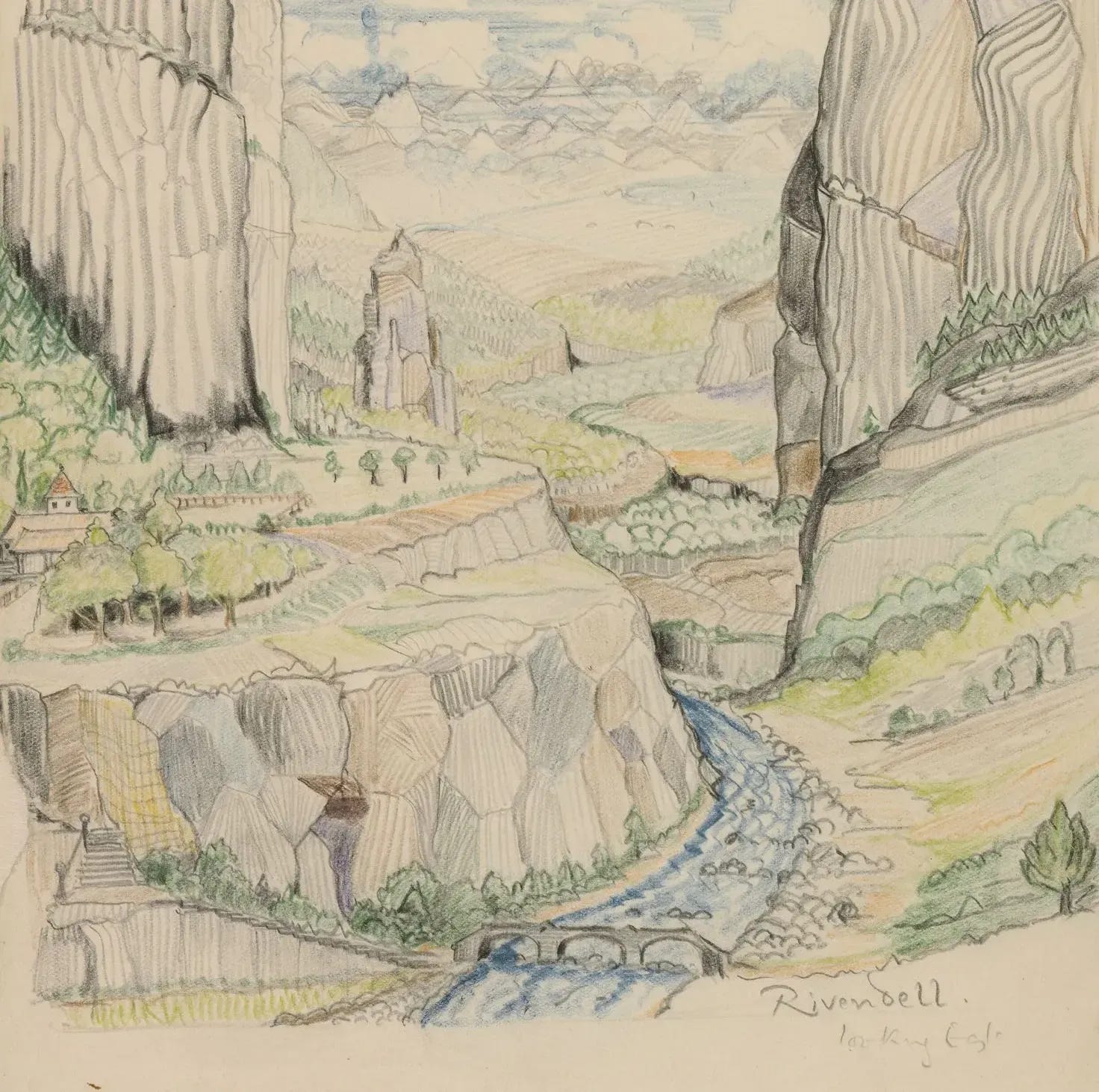
Unlike art which is content to create a new secondary world in the mind, [machinery] attempts to actualise desire, and so to create power in this World; and that cannot really be done with any real satisfaction. Labour-saving machinery only creates endless and worse labour.
J.R.R. Tolkien
We’ve entered meteorological summer, and while I follow the seasons astrologically, I welcome any signifier of longer days. All light is light. The Nature Library has been quiet over spring since I spent one month at the Saari Residence in Finland as a NAARCA artist-in-residence, followed by almost two in the US with my now fiancé. It has been a glorious few months, I’ve read some excellent books, and I look forward to getting back into the armchairs of 122B Montgomery Street, which I’ve just realised aren’t actually there because they were moved to the Maritime Museum for the exhibition. I’ll pick up more chairs. If you visit the library this summer please be kind, I will be (certainly) sad and (probably) cold.
Summer at The Nature Library
The Nature Library will be open by appointment through June, with some rearranging in the space to welcome artist Ellie Swanston into it, giving me a good reason to finally tidy up the “storage room”. There’s also a new publication to come - the second, winter edition of The Index of the Colour of Water, tracing the colours of the sea in February alongside a new collection of descriptions of the colour of water from books within The Nature Library. Just email thenaturelib@gmail.com to arrange visit!
The Beach Today at Scottish Maritime Museum
The Beach Today: A Year of Sea, Sky and Stone is open at the Scottish Maritime Museum until August 6th, exhibiting both iterations of my Beach Today series as well as a specially curated Nature Library collection and cabinets of curiosities containing pebbles, sea glass, the bones of birds, pipes and pottery shards, a clay inkwell, shells pearlescent and barnacle-scarred, and more. I very much hope you can visit.
World Ocean Day with the Marine Conservation Society
On Wednesday 10 June from 7-8pm I’m hosting a creative writing workshop with the Marine Conservation Society, celebrating both World Ocean Day and Scotland’s National Year of Reading. Free and open to all!
Readers of Edinburgh
In another Year of Reading celebration, Tills Bookshop is hosting a free photography competition, Readers of Edinburgh, and I’m excited to be part of the judging panel. Send in your photographs of the unseen places where reading happens across Edinburgh — home bookshelves, bedroom reading corners, a grandmother’s wild collection, portraits of people with their books. I wish I could submit.
A book made for books
As part of my NAARCA residency at the Saari Residence, I made a new logbook for their growing ecological library. Bound with an exposed French stitch binding, the book is made of two parts: the front is titled with a card of handmade paper created from extracts printed and displayed on the library wall throughout my residency such as Mary Oliver, Maria Puig de la Bellacasa, Merlin Sheldrake and Ross Gay. Turn the book over and you can use it as a logbook, marked with handmade lichen paper, for things seen and heard in Saari’s surrounding landscape — the cranes flying over at dusk, the deer in the yard at dawn, the first flowers emerging from the ground at the path’s edges. I’m enjoying making books and plan to make something similar for The Nature Library. If you like making books too, stay tuned for some beginners workshops coming soon.


* * *
Say what you want about the state of the world today, and there’s plenty to say, but the Scottish Parliament is now home to a record number of Green MPS, which is possibly the best electoral result I’ve woken up to in all my voting years. It’s a small but certain shift, proof of momentum in a direction that can so feel resolutely unreachable. It feels particularly exciting following last month’s visit to Oodi in Helsinki which had me thinking, no, dreaming, of the ways a government can look after and respect its people. Much of today’s politics is something of a scripted nightmare, but if political opinion and action can swing so steeply across the spectrum in one direction then the status quo can—with effort and conviction and Mary Oliver’s fighting, screaming kind of hope—be challenged and pushed aside in the other direction, too. We know what it takes to make greens grow. I hope, too, that an increase in capital ‘G’ Green votes and representatives leads to a rise in lowercase ‘g’ green politics, although in a way, in the classic sense of ecological policies, there shouldn’t even be a need for a Green Party in 2026 because every party should be serious about tackling these problems and protecting their people from the impacts of climate change, building a society which looks after itself, which is to say, not only its people, but all that its people rely on for a good life.
My introduction to green politics as something that can engender, effervescently, an eagerness for and real belief in something better, came reading Seeing Green: The Politics of Ecology Explained by Jonathon Porritt. It stirred, too, the useful kind of rage certain books evoke (such as Carson’s Silent Spring, the reason The Nature Library exists). Reading it some 40 years after its publication made its message all the more urgent. I could see in its pages a graph: the steep curve of knowledge on environmental degradation, climate change, biodiversity loss and their impact on social, economic and security issues, bending like a crowbar1 away from a stagnant one of current political action.
J.R.R. Tolkien died in 1973, over ten years before the publication of Seeing Green, and while I don’t know how aligned he’d have been with Porritt’s views overall, they both understood the need for the natural world to be taken care of. Middle-Earth could only have been created by someone who notices and, crucially, cares about how people (or hobbits, or elves) live upon the land. It’s a world built sensitively in Tolkien’s mind, and not a humble house or grand fortress is built without consideration of its natural surroundings, creating a considered relationship to place that shapes the culture of its inhabitants. It’s easy to love the petals of a meadow fluttering in a late spring breeze, tulips bursting open with their tongues splayed, making out with the air thick with pollen. It’s easy to love distant mountains when their frosted shards catch the morning light. But humans do need to break ground for places to live and materials with which to build them, among other things. We have to extract and harvest, and while it’s difficult to do this in ways that are loving, it’s not impossible, and Tolkien works to find them in ways that seem effortless (as is so often the result of painstaking work). I think the two of them would agree that, as Porritt says, “in caring for the planet, we are actually caring for ourselves”. Could it also be true that by caring for people, we are also caring for the planet? Does a government which looks after its citizens, valuing their abilities and potential, their time, their feelings, their attention, create a society which is altogether more ready to care for the land and its many lives, human and non?
It is not our part to master all the tides of the world, but to do what is in us for the succour of those years wherein we are set, uprooting the evil in the fields that we know, so that those who live after may have clean earth to till.
The Return of the King, J.R.R. Tolkien
Aged 13, 14 and 15 when Peter Jackson’s screen adaptation of Tolkien’s The Lord of the Rings came out, I’ve watched its Appendices—an extensive series of behind-the-scenes films on how they brought this world from book to screen—with a rhythmic ritual for the past twenty (!) years. After finally devouring Tolkien’s books in my 30s after some failed attempts in my teens and twenties, two things happened: I immediately placed it on the shelves of The Nature Library, and I fell more deeply in awe of what Jackson did with his trilogy (despite Tolkien deeming the tale inadaptable to the screen and suffering some disastrous attempts in his time, saying “I deeply regret the handling of the ‘Treebeard’ chapter” of one attempt, “whether necessary or not. I have already suspected Z of not being interested in trees: unfortunate, since the story is so largely concerned with them.”). And while most, Jackson included, would agree that Tolkien would have had qualms with some elements of the films, there are plenty of ways in which which the two mirror each other in the means of their making.
So largely concerned with trees was the story that Tolkien referred to it as his own “inner tree”, the writing process transforming him half plant, half animal. I think there’s something in this, in the process absorbing you so fully that you in turn absorb the process. In The World of Living Green, Kathleen Raine wrote that “Our eyes are, if we are poets (and most of us are sometimes), forever gathering flowers from the real fields and trees and riversides of the earth, and weaving them into a world of thoughts”. In her collection Stone and Flower she feels a poem as though it’s a physical thing emerging from inside her, “rain stones inserted in my breasts” trying to get out “if only the lips may speak / if only the god will come”. By engaging personally, spiritually, emotionally, directly with the natural world and with any art we choose to make, it becomes a physical part of us. I’d say it takes up space within our soul. This is not to say that Tolkien truly had a tree living inside him while writing The Lord of the Rings, but it’s also to say that he did.
Jackson, too, demonstrated a means of creation which enters and becomes the body, which I don’t think is a coincidence. Tolkien wasn’t exactly against all technological progress, but was deeply wary of the scale and heedless use of machinery while watching the rural home he knew be engulfed by the industrialisation of England’s towns, and what I endlessly admire of Jackson’s trilogy is the commitment to the (comparatively) small-scale while making a considerably large-scale movie. His love of the handmade. The props, the design, down to the tiniest crevices carved into a miniature (or as they coin them, bigatures) so that when digital effects come into play, there’s somewhere for a bird to flutter out from. The Return of the King has a particular scene I’ve been thinking about a lot lately, or rather, thinking about its making. In the deep caverns of the Paths of the Dead, Aragorn, Gimli and Legolas find themselves faced with an avalanche of human skulls, pouring down from the towering walls. Working with physical props, Jackson initially figured that the miniatures team would need to make a few hundred skulls to create a convincing cascade, but soon realised this wasn’t enough. A few hundred became a few thousand, and then some tens of thousands. In the end, around 80,000 skulls were handcrafted by the Weta Workshop team, entombing the actors in physical manifestations of the time, skill and passion of their colleagues. This wasn’t all, though; those 80,000 tiny skulls were only for the wide shots, and so when the actors come into play it all has to be filmed again with life size skulls. My favourite part in the behind-the-scenes footage is while watching the bones fall and clatter onto the set, the three men clambering through them and, from the director’s chair, the sweet sound of giggling as Peter Jackson watches on with glee. What a way to make a living. What a way to be joyful in making something for others to enjoy, surely passing that energy on in a way we can’t quantify but exists in some unmeasurable form.
Jackson, the actors, the designers, the makers, they would have sat down to watch this movie and remember how it felt on the day, they might even giggle again in their seats. They remember the event as something that really happened, because it did. Jackson’s The Lord of the Rings is rightfully a feat of world building, all of it helping the makers and actors and stunt people experience a world and a situation convincingly. And, as viewer, it matters that what we’re seeing on screen exists, has been touched and made by human hands. We can feel it, I think. When Weta’s miniatures team physically builds a city so that the cameras can glide through its streets, we know that this city is a creation of the storytellers, but equally, we know that it’s real. However, when actors spend all their days surrounded by green screens I wonder if it only (surely) leads to flatter performances, flatter movies, where we can enjoy it to a degree but know on some level that it never really happened.
When asked to talk about what I do, I’ve often compared writing with handicrafts—weaving, pot-making, woodworking. I see my fascination with the word as very like, say, the fascination with wood common to carvers, carpenters, cabinetmakers—people who find a fine piece of old chestnut with delight, and study it, and learn the grain of it, and handle it with sensuous pleasure, and consider what’s been done with chestnut and what you can do with it, loving the wood itself, the mere material, the stuff of their craft.
No Time To Spare, Ursula K Le Guin
In the (movie) appendices, the story seems to become the inner tree of the cast and crew just as certainly as it did with Tolkien, only theirs is one they can climb, build dens in, jump from its limbs into piles of leaves, tangle in cobwebs they created in a deep fat fryer always a degree or two away from bursting into flames (such is the fun of it, they grin). We’re told today that technologies such as generative AI has come to ease our working day, to make us more efficient, to help us out, but does it give us work that we enjoy? That nourishes our sense of play, of thought, of craft, of kinship? Or does it strip it of these human elements, leaving mindless tasks that makes us feel thin, like butter spread over too much bread, you could say. I watch The Lord of the Rings’ labour intensive set in action and wonder if the people behind the job titles — model maker, greensmaster, hammerhand, rock & foam, prosthetics makeup, sword smith, miniature builder, creature lead, matte painting coordinator, render wrangler, inferno artist (separate to flame artist), focus puller, horse trainer, choir master, carpenter, lighting technician, set dresser, sculptor, wig technician — actually want this labour taken away from them. I recently read Karen Hao’s Empire of AI2 and one of the most striking revelations (of many) was how few people can really tell us what it is these companies are trying to do, what their purpose is, why we should want generative AI to take away our creation of physical art and critical thinking. It can write, it can make art, but only by regurgitating what humans have already made themselves. It seems, increasingly, to take human beings out of their own lives; we’re turning robots into humans and humans into robots, and so far, no one can tell me why.
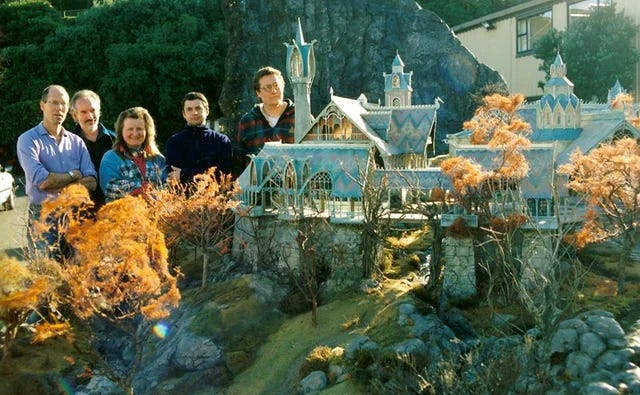
Tolkien was wary of the scale and heedless use of machinery while watching the rural home he knew be engulfed by the industrialisation of England’s towns in the middle of century. The new technologies we experience are less tangible, at least in our daily lives, than the industrialisation Tolkien experienced, and make me think of Jackson, in the beloved appendices, trying to depict the Eye of Sauron for film and the challenge of trying to give weight and power to a disembodied representation of evil. We’re no stranger to bodiless technologies seeping into every aspect of our lives, a deluge of software and apps which drain our attention, watch and track our actions and faces (please don’t share how you looked 10 years ago), scrape our data (turn us into data, even). In an age where so much of our life exists online, from personal correspondence to careers, it’s no hyperbole to say that it scrapes away at our lives, our very being.
Recently, sparked by a flurry of ominous articles about a surveillance company, I typed a search query which read something along the lines of “origin of palantir”. The company was new to me but, as the owner of a twenty year old cardboard cut-out of Aragorn, son of Arathorn, its name was not. In The Lord of the Rings, the palantíri are a set of seeing stones made in part for communication but also, crucially, to spy on the occurrences of other realms and enemy plans, and I wanted to know what came first: the name or the stone. I wondered if, while writing The Lord of the Rings, Tolkien called his palantíri by this name because of the word’s existing meaning: some kind of watching, looking, surveying, spying, but (of course) that isn’t the case. The word palantir was created by Tolkien himself from two other words of his own doing (such is the complexity of his language and world building, brand new words are born already with deep roots3, languages carved like a fine piece of old chestnut). From the Elvish Quenya language meaning “far-seer”, it’s formed of palan (“far and wide”) and tir (”to watch over”), essentially translating to “those that watch from afar”. I get the intention, but as weapon of the evil and corrupt and it is not, I don’t think, what you should name a company that you expect people to trust. It is not, I don’t think, something you should name a company who relies on grossly resource intensive technologies. Uses of the palantíri are not exclusively by evil forces, but even when used by Aragorn to successfully draw Sauron’s attention away from Frodo and the Ring it’s with caution, and, vitally, used only by himself as the “rightful owner” of such a tool, acknowledging that it’s “Dangerous indeed, but not to all. There is one who may claim it by right … Now my hour draws near. I will take it.” One of the baffling things to me about the introduction of tools such as generative AI is how quickly it’s been forced into the hands of literally anyone who will take it, and many who don’t want it. It is not being used with caution, and I think of E.F. Schumacher in Small Is Beautiful considering how ordinary people are supposed to cope with “the problems thrown up by technological progress”. “Science and engineering produce ‘know-how’; but ‘know-how’ is nothing by itself; it is a means without an end, a mere potentiality, an unfinished sentence … There is no doubt also the need to transmit know-how but this must take second place, for it is obviously somewhat foolhardy to put great powers into the hands of people without making sure that they have a reasonable idea of what to do with them.”
‘Strange powers have our enemies, and strange weaknesses!’ said Théoden. ‘But it has long been said: oft evil will shall evil mar.’
The Lord of the Rings, Book 3, Chapter XI: ‘The Palantír’, J.R.R Tolkien,
The data centres that companies such as Palantir rely on consume volumes of water hundreds of times greater than the populations of their nearest towns (towns which are often already drought-stricken). One data centre proposed for Scotland is being challenged by the community in the Borders, as well as a 61 acre project in Fife. And yes, the materials required for AI—water, lithium, copper—are already needed for other less abrasive technologies; people who are against AI probably regularly use smartphones, but that doesn’t mean we can’t question or have concerns about the scale and speed of AI growth and the resources that it’s using up. A person can partake in society while still thinking it could be improved somewhat, etc. We can, in our current capitalist system whatever you might think of it, require and so seek money in order to get groceries or pay rent or buy a new pair of jeans and still consider robbing a bank excessive. In The Two Towers, cursing Saruman for the destruction of the forest, Treebeard laments the unfolding fight between nature and industry and mourns the needless deaths of friends he had “known from nut and acorn”. If the materials can’t be extracted without destroying the land along with Earth’s (or Middle-Earth’s) inhabitants who rely on and love that land, then it’s back to the drawing board.
Our understanding of ‘efficiency’ must necessarily change in an age where we have a surplus of human beings and a shortage of non-renewable resources, for only in a labour intensive society will it be possible both to conserve the Earth’s resources and ensure that the wealth of human resources are expended for the benefit of fellow humans.
Seeing Green: The Politics of Ecology Explained, Jonathon Porritt
Anyway, maybe an increase of green thought in the little glasshouse of Holyrood leads to the blooming of something better, moving towards a kind of living which relies on thought and skill and making, work that makes us feel alive, that makes us feel human. I’ll end with a recent, always exquisite Green Thought from Garth Greenwell on the politics of art, and the value of our attention to it.
The art I care about most, the art I want most to make, is an art of radical devotion to the particular, of infinite exquisite untrammelled uninstrumentalized attention. Effective political action requires the shutting down of many kinds of attentiveness, it requires the marshalling, the weaponizing, certainly the instrumentalization of attention.
Garth Greenwell
book of the month
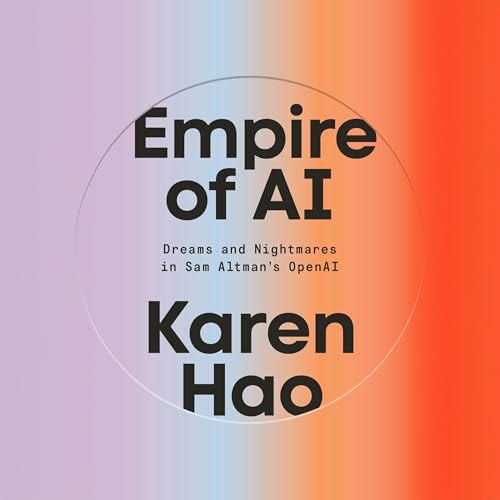
I’m currently sitting in the Portland public library where I borrowed Karen Hao’s Empire of AI, which has been on my mind a lot this month and throughout writing this letter. For something that’s infiltrated so many aspects of our lives, from leisure time to how we communicate and share things with our loved ones to our working days and future careers, AI has been imparted on us with little question. Hao tracks its inception and mutations from the beginning in a way that’s both accessible and thoroughly researched.
Lithium is a more recent discovery [in Chile], stumbled upon by an American company in the 1960s as it searched for the water it needed for copper mining. When it drilled into the salares, it found high concentrations of lithium floating in an oily brine beneath the surface, opening up a new front of extraction and accelerating the depletion of more ecosystems. Today Chile produces roughly a third of the world’s lithium, second only to Australia. The material is primarily extracted out of the Salar de Atacama, the largest salt flat in the country, by pumping its brine out into shimmering pools of turquoise and waiting for the sun to evaporate and crystallize the solution into lithium and other by-products. The salares were once home to flocks of pink flamingos, which the Atacameños consider their spiritual siblings. Now the flamingos are gone; the young daughter of one Indigenous leader in the Peine community has only her ancestors’ stories and a flamingo plushie by which to remember them.
found in books
I don’t have access to my latest ephemera found in the secondhand books that fill the library shelves, so here’s one I found earlier. A sprig of clover, I think, tucked into the pages of Tramping in Arran by Tom S. Hall; imagining, of course, hoping, that it was plucked from the slopes of Goat Fell.


Currently reading The People in the Trees, Hanya Yanagihara
There were so many shades and tones of green—serpent, aphid, pear, emerald, sea, grass, jade, spinach, bile, pine, caterpillar, cucumber, steeped tea, raw tea: how inadequate is our vocabulary for colour!—that I feared I would lose my ability to distinguish anything else.
The People in the Trees, Hanya Yanagihara
Also mentioned in this issue Empire of AI, Karen Hao / Small Is Beautiful, E.F. Schumacher / The World of Living Green and Stone and Flower, Kathleen Raine / Silent Spring, Rachel Carson / Seeing Green: The Politics of Ecology Explained, Jonathon Porritt / No Time To Spare, Ursula K Le Guin / and of course, The Lord of the Rings, J.R.R. Tolkien
Read about the extraction of mineral and water resources in this extract of words from Karen Hao’s Empire of AI.
Look at my favourite ballet company, Scottish Ballet, photographed by one of my favourite photographers, Karolina Kuras, on the streets of New York.
Read and watch about Peter Jackson’s bigatures in the latest edition of The Rad Times.
Visit The Beach Today at the Scottish Maritime Museum, open daily 10-5 until August 2.
Spend hours watching this man cut agates open.
Applaud, if you feel so inclined, the campaigners in the Scottish Borders opposing a £2bn rural data centre.
Read four reasons why the final sprint of spring is the perfect time to read Kathleen Raine’s The World of Living Green.
Imagery borrowed directly from the lyrics of Crowbar by Waxahatchee.
I haven’t yet read Heather Parry’s essay on Hao’s Empire of AI because I feared if I did, I’d never get this out on time, but I’m confident in recommending it blindly.
Take also Rivendell, meaning “deep valley”, and Lothlorien, meaning "dream-flower" from the Sindarin loth ("blossom, flower") and Quenya lórien ("dream, slumber").
I love that you're reading the Hao (and People in the Trees is one of my favourite books!!)