
what pushes through ice
02/26, on fear, florals and Frodo

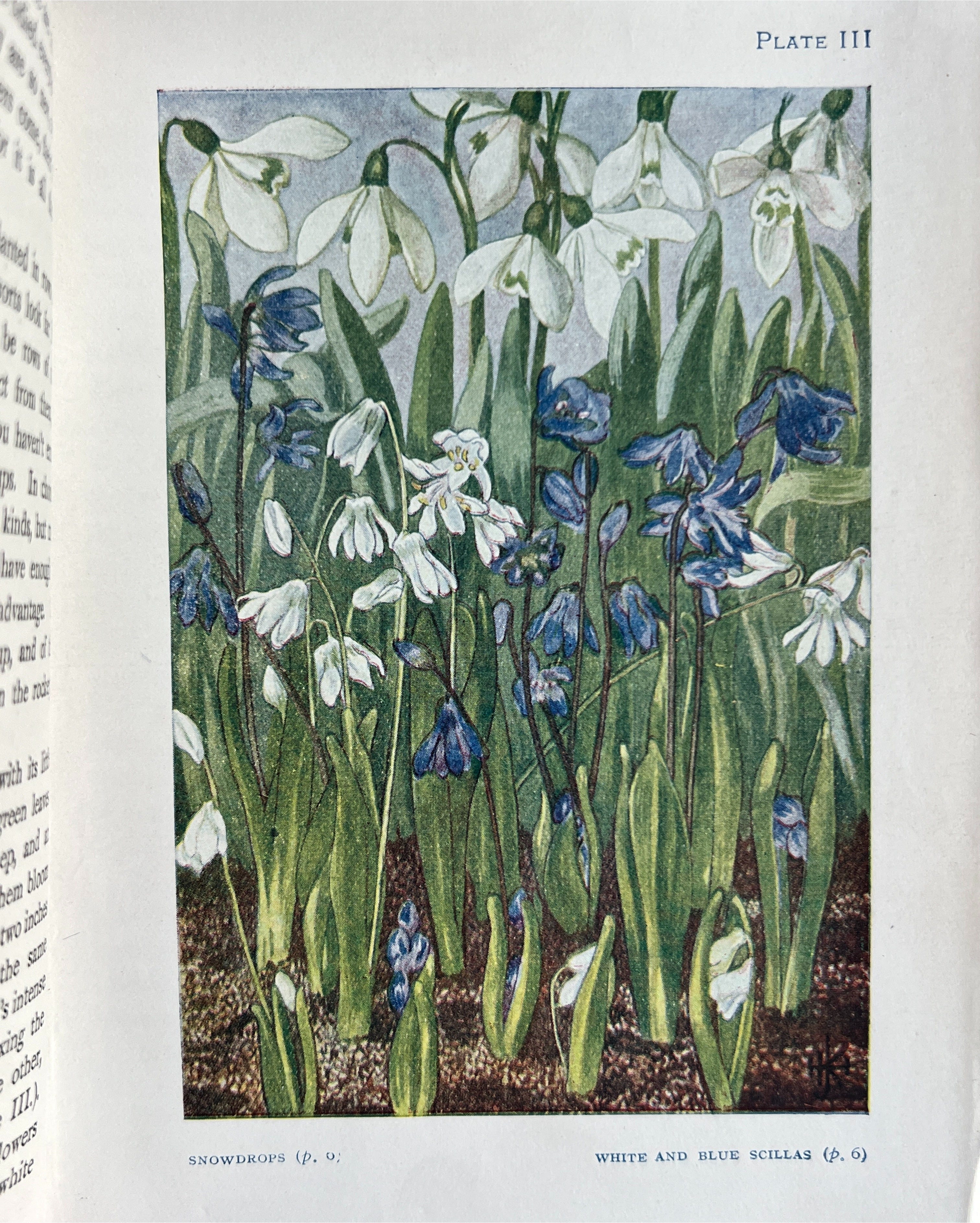
I said “I just want to tell people what’s happening and when without accompanying it with an essay”. That will surely sometimes be the case, but these past few weeks leading to Imbolc had me thinking of things that push through ice, digging through the library shelves for snowdrops, so I’m sharing that here with news of upcoming talks and workshops, a residency, the colour of water, a new song/book relating to last month’s grappling with flourescent light, and two new features in an aim to share bits and pieces from the library somewhere other than Instagram. I hope they’re enjoyed by those who can’t visit in person, and also by those who can. Thanks for reading.
news and upcoming things
As part of St Andrews Botanic Gardens’ Treasures of the Deep programme, I’ll be speaking about underwater art and how Looking Down at the Stars came to be on Wednesday 11 February. Then on Saturday 15 March I’ll be running a seaweed cyanotype and nature writing workshop, looking at women from Anna Atkins to contemporary artists to consider how we interpret and archive the natural world.
I am utterly thrilled to be one of three 2026 NAARCA Residency Exchange artists, a programme by Cove Park, Artica Svalbard, Narsaq International Research Station, Saari Residence and Skaftfell Art Center focused on the climate and biodiversity crises, climate justice and the four pillars of sustainability – ecological, social, psychological and cultural. I’ll be going to the Saari Residence in Finland to learn from and work on their growing ecological library and consider how knowledge and stories are shared and cared for throughout the natural world. (Related: The Nature Library will not be open to visitors from the end of March for a little while.)
This is the last week of the Texas Photographic Society International Competition, judged by Nature Library favourites Barbara Bosworth and Emily Sheffer, where my photo Gowing’s Swamp in winter is on show. If you happen to be in Texas it’s on until February 7, otherwise you can view the online gallery.
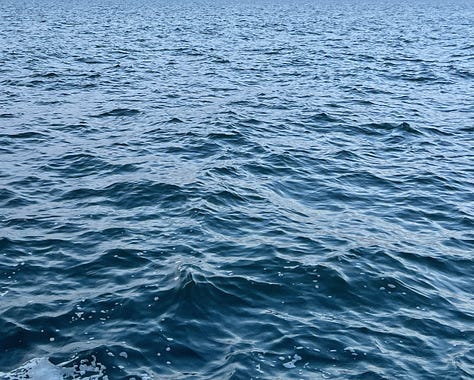
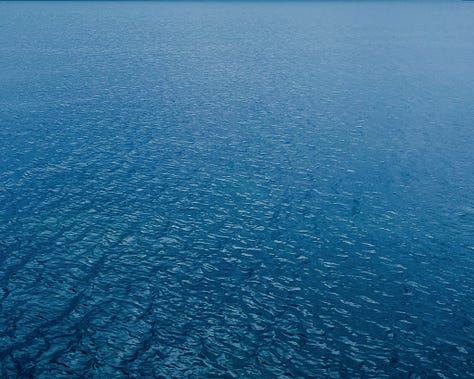
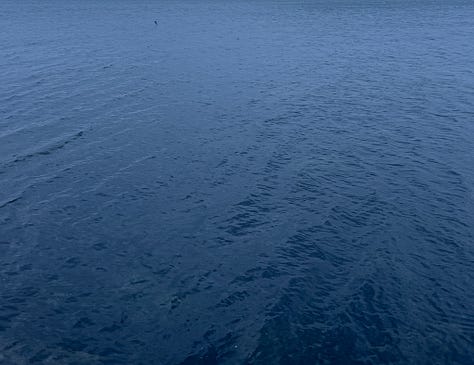
I am once again photographing the colour of water for a new edition of An Index of the Colour of Water, an artists’ book documenting the colour of the sea every day in February alongside descriptions of water from books on the Nature Library’s shelves. It likely won’t be made until later in the year but you can follow the daily recordings on Instagram and look at last year’s spring edition here.


The Nature Library remains open by appointment, welcoming individuals and local groups this month, and… you? Email thenaturelib@gmail.com to arrange a visit.
what pushes through ice
In Looking Down at the Stars I wrote,
Sometimes I imagine world leaders – the ones doing the land grabbing, the ones killing and getting others to do the killing for them – I imagine them frolicking into the sea. I imagine them on their knees staring into rock pools, or running out the house in their pyjamas to see the aurora borealis dance above their head, gazing upwards, letting magnetic light fall from the heavens into their open mouths, standing next to their neighbour and feeling, fleetingly but collectively, that right now this is the most important thing. Everything else is nonsense.
It has been noted (by Meg Bertera-Berwick during our utterly delightful conversation at Mount Florida Books) that this is quite… generous. I’ll clarify now, as I did then, that this is not all I imagine when I think of these people. It’s not all I think of when I see humans acting inhumanely. But it’s one of them, and it’s happening again. Men (and it is predominantly men) working for ICE are separating families, tackling their fellow man to the ground on no grounds. Killing them. Al Jazeera reported that there were 32 deaths in ICE custody in 2025. We’re one month into 2026 and already six people have have died in the custody of Immigration and Customs Enforcement agents. Alex Pretti and Renée Nicole Good were shot and killed on the streets of Minneapolis. The news continues to stun us, some into paralysis and some into rage and grief and many into a nauseating cocktail of all three. Some, apparently, into delirium: I picture these men, these ICE agents, in a meadow. Falling to their knees admiring their tiny, transient kin bursting forth to experience their own brief moment alive on this earth. I imagine them noticing, as we crawl out of winter, the colour returning to the land. When was the last time an ICE agent looked at a flower? What went through their mind?
I recently dreamt of the end of the world. I didn’t know how it was ending, but I felt distinctly that, in the words of Josh Schwartz, “the end's not near, it's here”. I was in some kind of multi-story and everyone was packing their cars and running to the toilets for a final relief before they set off. To get to them I had to squeeze under corroded railings that stuck into my palms, like the whole place had been sunk underwater and left to rust. The rich were fighting the poor and the poor were blowing up expensive cars, which were parked right next to other expensive cars, thus killing two birds with one stone, which particularly annoyed the Tesla owners. (Side note, if anyone knows of a kinder term than to kill two birds with one stone, I’d appreciate it.1) One thing weighed equally over us all and I felt it as keenly as though awake: fear. Everyone was experiencing fear in a society taught not to show it and so, when we do, it’s often expelled in violent forms. I wrote ‘violet forms’ by accident. Imagine that. If fear formed flowers, a growth more colourful than cancerous, offering a little more life. That’s any emotion, right? Depth of feeling, the full human experience, whatever that is.
In a letter written to his son in 1941, J.R.R. Tolkien credits fear as leading him to poetry, via a cloud:
Do I not remember [fear]! I never expected to survive; and the intense emotion of regret, the vivid (almost raw) perception of the young man who feels himself doomed to die before he has ‘said his word’, is with me still: a cloud, a patch of sun, a star, were often more than I could bear. … I said, outside Lichfield Cathedral, to a friend of my youth — ‘Why is that cloud so beautiful?’ He said: ‘Because you have begun to write poetry, John Ronald.’ He was wrong. It was because Death was near, and all was intolerably fair, lost ere grasped. That was why I began to write poetry.
He describes Frodo as “a study of a hobbit broken by a burden of fear and horror — broken down, and in the end made into something quite different.” Are emotions physical, if they can reshape and transform us? If fear can break down a person, make them something else, if it can disfigure an entire country, can joy, could delight — I mean it — put it back together? Tom Bombadil he described as “master in a peculiar way: he has no fear, and no desire for possession or domination at all”. Throughout the story, the strongest are those who do not seek power, even when they hold it in their hands (or around their neck). A desire for possession and domination isn’t what makes someone powerful but weak, grasping, and no less dangerous in their throes of insatiable wanting.
Writing this, and The Lord of the Rings, throughout the Second World War, Tolkien muses in this same letter that women are in many ways braver than men. Their fear is fed by the harmful ways that men deal with their own. Reading this the first time, I immediately got defensive; my fear is my own! But on closer inspection, yes. If I consider what I have feared most throughout my life, beyond a premature death of my loved ones and myself, it’s fair to say that men and their actions are at the heart of it. Women do not, he says, die for glory, honour, or “the King”, but they watch those they love die for such things and live through the aftermath. The world, he notices, is made mad by the “wild fancies” of men. I read the news and feel as though I’m watching a bunch of teenage boys play a video game, as though any time someone opens their door and asks them to stop they’re simply ordered to get OUT and let them get on with their shooting and killing. I’ve fallen into the game, or the game, rather, has fallen into our lives, as real police officers kill real civilians in broad daylight and I want to tear the cord from the wall and scream ENOUGH! Get some fresh air, it’s good for ye.
Placing these people into scenarios of beauty isn’t, I don’t think, an act of generosity or kindness. I’m not trying to humanise the inhumane. It’s simply a coping mechanism because it is breaking my fucking heart. ‘ICE’ sounds like an element, and object, an entity, but these are fleshy mortal people forming a collective violence. Not so long ago they were toddlers, asking silly and disarmingly insightful questions, pointing at clouds in the sky and bugs on the ground. A few years later with lanky legs maybe they sprinted across yards or down streets just see how it felt, then did it again and again because it felt good, and they, as a child, had nothing to do, no other responsibility on the earth that they knew, than to discover what brings them joy. I don’t know what happened in the interim and I know that hatred is fertilised by multitudes and it’s naive to say that we can all be happy, gazing at the meadow, all the time, and I know that there are children who don’t zig-zag the streets with glee and instead bear more responsibility than a child should. I understand that some people work for ICE because it’s only the secure job they can find, which in itself, in one of the richest countries in the world (let’s not go into how we define “rich” right now – the United States boasts the highest total government debt in the world, over $38 trillion, what is money?), is absurd and a failure of the American, which is to say the essentially global, economic system. I’m just curious. I want to see that process. I want to know when a flower stopped being a flower.
In France, snowdrops are known as perce-neige. Snow piercer. Their leaves are hardened at the tip for breaking through frozen earth and in their sap is a form of antifreeze, preventing ice from forming. As we leave January behind, much of the world doesn’t feel like it’s changed much. I do not, amidst my hallucinations, think for one second that anyone working for ICE is laying down their arms to kneel at the foot of February’s first flower. The sturdy shoots of daffodils still a cool blue-green while the yellow and purple crocuses are vivid upon impact with the stinging northerlies. And the snowdrops, silken crowns nuzzling through frozen ground. I need to think of things that push through ice as a reminder that they can, and they do. “That Sauron was not himself destroyed in the anger of the One is not my fault: the problem of evil, and its apparent toleration, is a permanent one for all who concern themselves with this world”, said John Ronald. Every year the ice chills us to the bone, and every year the snowdrops just push it out of the way.
book of the month
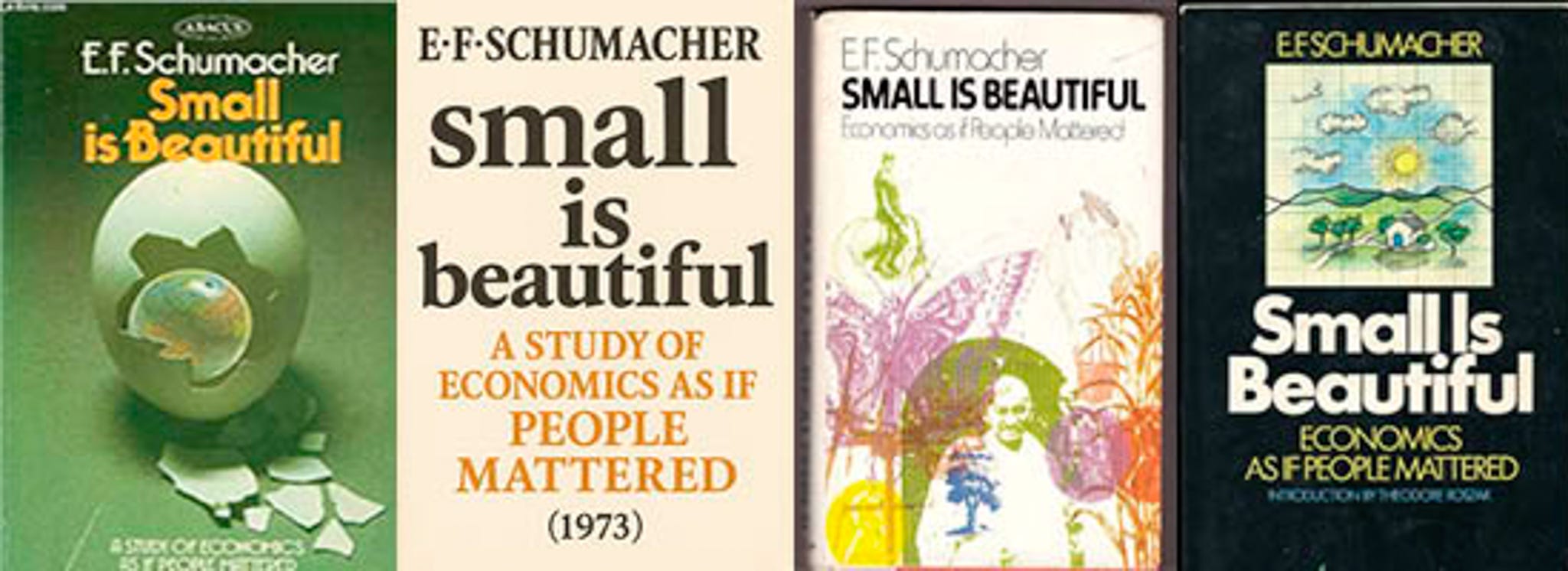
The burden of proof is placed on those who take the “ecological viewpoint”: unless they can produce evidence of marked injury to man, the change will proceed. Common sense, on the contrary, would suggest that the burden of proof should lie on the man who wants to introduce a change; he has to demonstrate that there cannot be any damaging consequences. But this would take too much time, and would therefore be uneconomic.
Small is Beautiful: A Study of Economics As If People Mattered by E.F. Schumacher has been on my to-read list for years, but part of me always knew I’d like it and agree with everything it said, removing any urgency for me to read it. If I didn’t agree with everything it said it’s mostly because I did not understand much of what it said, not being well versed in the language of economics, but the thing with economics is that it’s all kind of made up anyway, and the language can change, and Schumacher translates it into something that makes me say ‘Yes, exactly’. It feels like the Silent Spring of economics; written in 1973 and still arresting in its relevance.
Although ignorance and greed have again and again destroyed the fertility of the soil to such an extent that whole civilisations foundered … where people imagined that they could not ‘afford’ to care for the soil and work with nature, instead of against it, the resultant sickness of the soil has invariably imparted sickness to all the other factors of civilisation.
song/book
I’m still obsessed with What of Our Nature by Haley Heynderickx and Max García Conover, so here’s Fluorescent Light, a straw of a song breaking the proverbial camel’s back, with Perfection by Vincenzo Latronico, a book I loved last year, which does a similar thing, if a little more subtly, even forgivingly.


They will make time to take some photos for Instagram, but will struggle to crack a smile as they think about all the work still to be done. They will drop barbed remarks about the weekend’s hitches, without proposing any solutions. They will drink at lunchtime, doze off in the sun, and wake up feeling foggy and sluggish, with a pounding head and too much to do. But then they will receive notifications of the first reviews, and all that weight will instantly lift. Three will have come in, all of them giving five stars. One will be by a woman with over three hundred thousand followers, who will have tagged them in a post praising, as per their agreement, the relaxed but impeccable welcome, the choice of natural wines, the simple, elegant decor—Mediterranean and yet unmistakably international. It’s all completely perfect, the story will say. It’s just like it is in the pictures.
Perfection, Vincenzo Latronico
They caught us in the bleakness / They caught us on our screens / Brilliant minds go to college / Just to study marketing / There was an ancient light / There was an ancient song / Now something isn’t right / Now we live in fluorescent lighting
Fluorescent Light, Haley Heynderickx and Max García Conover
found in books
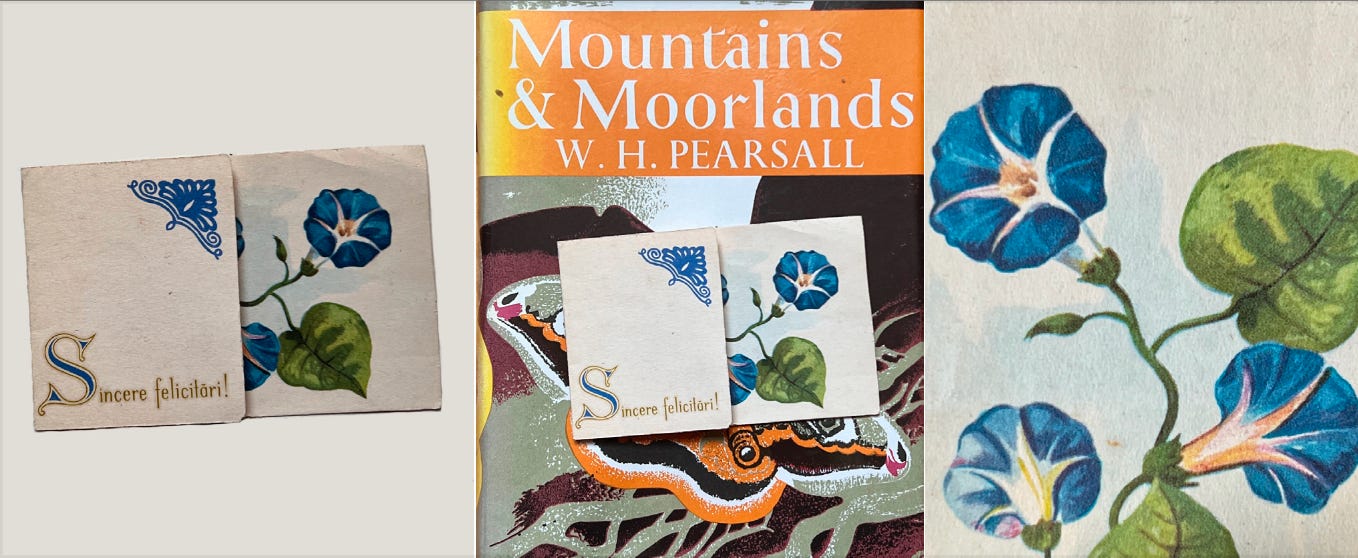
An outlet for sharing the various exquisite ephemera that occasionally turns up in secondhand books bought for The Nature Library. This month, some Romanian well wishes found in W.H. Pearsall’s Mountains & Moorlands, from the New Naturalist series.
Currently reading: Horse, Geraldine Brooks
Go: Zain Rishi is launching his debut book Noon (The Emma Press) on February 19 at Topping and Company, Edinburgh. Thanks to the wonderful Emma Press, a copy of Noon is available to read at your pleasure in The Nature Library.
Sign: Glasgow’s Centre for Contemporary Arts, a past venue for The Nature Library as part of Take One Action Film Festival and an indispensable part of Scotland’s contemporary art scene, is set to permanently close after financial concerns from issues with payments, unexplained expenses and financial irregularities. There’s a petition to urge Creative Scotland and the Scottish Government to take immediate action to prevent CCA’s permanent closure, please sign it here.
Browse: The Fruitmarket’s Artists’ Bookmarket is back on the 14th and 15th of February, I enjoyed it very much last year.
Read: I still have many Shadows and Reflections to catch up on, but I read and was broken and mended by Annie Lord’s love and grief taking the shape of wreaths, potato prints and frost flowers.
Watch: A Line in the Sound, a new film by Seaful, premieres on the 14th of February and includes a panel discussion with members of the Our Seas coalition, discussing how to make real marine protection in Scotland a reality.
I turn to Adam Sharp’s ‘The Wheel Is Spinning but the Hamster Is Dead’ and learn that while many other versions of the phrase ‘to kill two birds with one stone’ from across the world are equally violent, in Korea they say, instead, that ‘She both picked mulberries and saw her lover’.